|
|
|
|
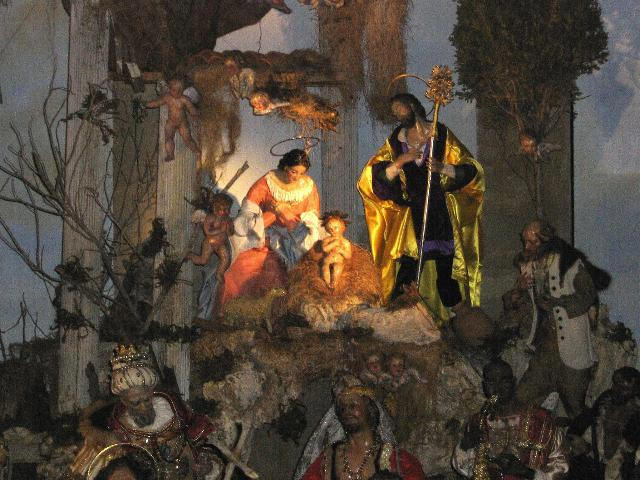
Wherever Christmas is celebrated, the CRIB forms part of the country’s tradition and our little island is no exception. As early as the month of October, statuettes, popularly known in Malta as ‘pasturi’, are put up for sale in shops. The word ‘pastur’ is derived from the Italian ‘PASTORE’ which means shepherd. It is commonly known that shepherds were the first persons to rush to the manger where Baby Jesus was born in Betlehem. The idea of crib building originated in Italy where St Francis of Assisi re-enacted the Birth of Christ in the year 1223. From here it spread all over Europe and eventually the World, each country adapting the crib to its own traditions, trades and style of costumes. Crib
building in Malta is said to have started in the first half of the seventeenth
century, and although no documentation could be found to prove it, it is known
that a crib used to be erected every Christmas at the Domenican Conventuals
Church in Rabat as early as 1617.
In St Peters Monastery in Mdina, one can still find a crib dating back to
1826. This crib is attributed to the works of Fra
Benedetto Papale, a Sicilian monk who lived in Malta around that time.
It
is
treasured by the Benedictine Sisters who live in the monastery. Towards
the middle of the nineteenth century, a certain Antonio Muscat Fenech from Qormi,
built a
The Sicilian style of crib, was introduced in Malta by a Franciscan friar from Sicily, Benedetto Papale, who is known to have lived in Malta for some time during the second half of the nineteenth century. One of his cribs can still be seen in Modica, Sicily. This style was more acceptable to the Maltese, perhaps due to the likeness between the Maltese and Sicilian countryside depicted in the cribs. Even so, the Maltese crib followed local traditions with regards to trades, costumes, musical instruments and buildings which formed the crib. The Maltese farmhouse and flour windmill still feature prominently in locally built cribs. The building of cribs in Malta flourished during the nineteenth and first part of the twentieth centuries. The media most commonly used were rustic stone, very abundant in Maltese countryside, and coal residue, commonly known as ‘gagazza’. The latter was generally acquired from blacksmiths. These two media, patiently built, formed the desired basic shape of the crib. After Christmas they could be dismantled and stored away for the following year. The introduction of modern fuels in furnaces did away with coal and therefore the supply of ‘gagazza’ became very remote, while the use of stone was rather cumbersome. So crib enthusiasts turned to another medium, papier mache. This made cribs more solid and lightweight; however it presented a problem of storage. For this reason, cribs were very often destroyed after Christmas Another interesting aspect of the Crib is the evolution of the statuettes or ‘pasturi’. The first artistic figurines were rather expensive and therefore beyond the ordinary man’s reach. So he devised his own method of making ‘pasturi’. Using earth clay, he shaped what looked like very rugged figures. Paint helped to define the face, hands and clothes.
Towards the middle of the 20th Century, and particularly after the end of World War II, new customs and traditions were brought into Malta from abroad. Local traditions and folklore were pushed aside. Both in Malta and abroad, the Crib became just another Christmas decoration and due to the work required in its building, it lost its popularity to make way for the Christmas tree and other easy to mount decorations. The mass production of plastic figurines, dressed in contemporary clothes and painted in bright styles, which looked more like miniature dolls or puppets, lacked the prestige of the individually made 'pastur' and helped to deteriorate the tradition even more. In the year 1907, the Society for Religious Doctrine, known as M.U.S.E.U.M., was set up. Urged by its motto, ‘VERBUM DEI CARO FACTUM EST’, which means: ‘The Word of God was made Man’, this Society, under the leadership of its founder, Saint George Preca, made it its task to re-kindle the love for the real Christmas. Each December, children were given a replica of Baby Jesus or a small crib as a gift. Another initiative of this Society was the holding of a procession on Christmas Eve during which a life-size replica of Baby Jesus was carried by members of the society while religious Christmas carols were sung. The first of these processions was held in 1921. Such processions still form part of the Christmas Eve scene in Malta’s towns and villages. The crib building tradition in Malta was also kept alive by a few enthusiasts who built sizeable cribs and exhibited them to the public. It was thanks to these persons that the custom of crib building in Malta did not vanish altogether. In 1986, a group of Crib enthusiasts got together and formed the ‘ASSOCIATION OF THE FRIENDS OF THE CRIB ’. The scope of the group was specific: to keep the crib tradition in Malta alive.
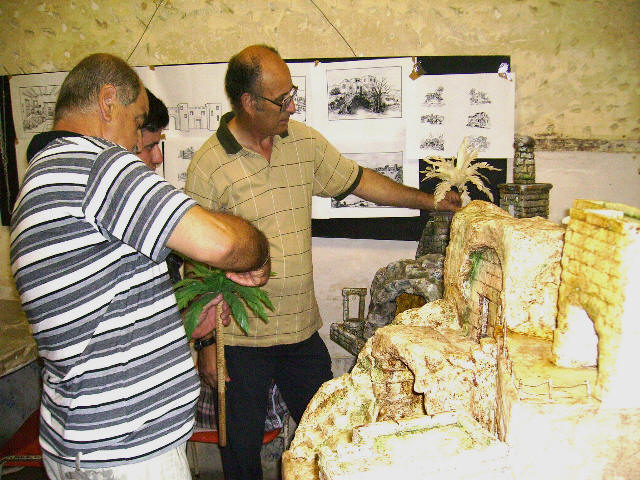
During the Every year, during the weeks preceding Christmas, the Friends of the Crib hold an exhibition of works by their members. About one hundred cribs of various shapes and sizes made from different media such as papier mache, polystyrene, cork, etc., are put together to offer visitors, locals and tourists alike, the true story of Christmas, THE BIRTH OF BABY JESUS.
While thanking you for visiting our site, we hope to welcome you to our show in
Valletta, Malta during a future
Christmas Season.
|
|
|

 mechanical crib which he opened for public viewing in his garage.
Water dripping on fins attached to wheels used to turn wooden shafts which
in turn, activated the movements of the statuettes in the crib. Due to the
visiting crowds, the crib was kept open until February.
mechanical crib which he opened for public viewing in his garage.
Water dripping on fins attached to wheels used to turn wooden shafts which
in turn, activated the movements of the statuettes in the crib. Due to the
visiting crowds, the crib was kept open until February. 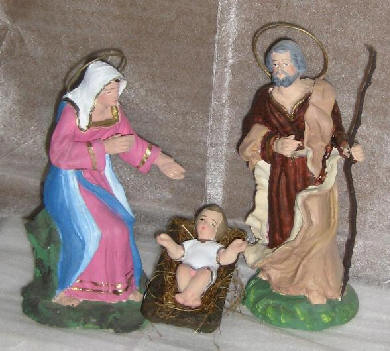 More enterprising, if not talented persons, created plaster moulds into which
soft earth clay was pressed to produce figurines. These were produced in
large numbers and sold for a ‘penny’ (today it would be
More enterprising, if not talented persons, created plaster moulds into which
soft earth clay was pressed to produce figurines. These were produced in
large numbers and sold for a ‘penny’ (today it would be